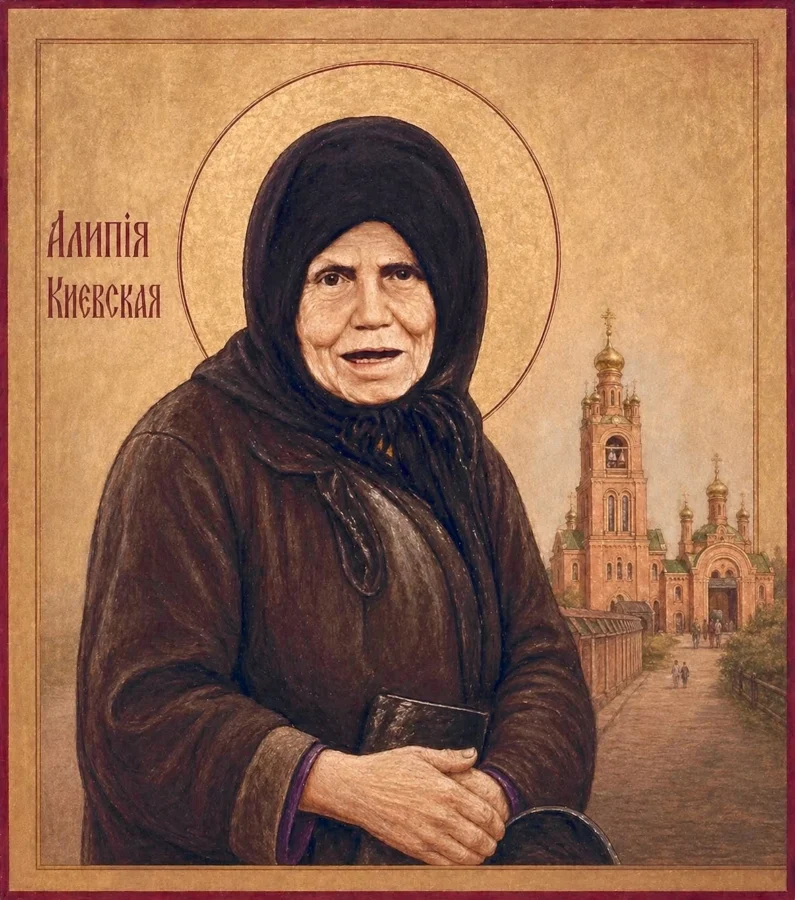
Матушка Алипия · Любовь, ставшая молитвой
Просьба к матушке Алипии
Здесь вы можете оставить свою просьбу или молитвенное обращение к матушке Алипии. Каждое сообщение будет принято священником и с вниманием передано ей в молитве.
Матушка Алипия · Любовь, ставшая молитвой
The story of Blessed Nun Alipia — from severe trials and decades of hidden spiritual struggle to a life of prayer, service, and boundless love for God and people.
The story of Blessed Nun Alipia is a journey from severe trials and many years of hidden spiritual struggle to service to others, prayer, and boundless mercy.
Given the many testimonies about the life and spiritual labors of Blessed Nun Alipia, it is important not only to recount individual events of her earthly journey, but above all to discern her spiritual image — that highest and most hidden reality for which she lived and struggled.
Mother Alipia never sought fame through miracles. The outward manifestations of her ascetic life were only means of attaining true life in Christ. The destiny of the Church was inseparable for her from her own destiny. She could not imagine herself outside the Church, outside prayer, or outside service to God and to people.
In the world, the Blessed Mother bore the name Agafia Tikhonovna Avdeeva. She had a special love for her heavenly patroness, the Holy Martyr Agatha. Later, one of the unusual aspects of her spiritual struggle was that she constantly carried an icon of the saint with her.
According to Mother Alipia herself, her parents, Tikhon and Vassa, were deeply religious people. Her father observed an exceptionally strict fast, while her mother was known for her mercy toward those in need and taught her daughter from an early age to give alms.

Throughout her life, Mother Alipia remembered her parents with great love and asked people to pray for the repose of Tikhon and Vassa, as well as for her relatives — Pavel, Euphemia, Sergei, and Domna.
Her parents regularly attended church and raised their daughter in the life of the Church. From childhood, Agafia displayed unusual spiritual discernment. According to her own words, she could inwardly distinguish between those who were going to church in prayer and those whose thoughts were occupied with entirely different things.
But her peaceful childhood did not last long.
When Agafia was nine years old, her parents were killed. Mother Alipia later told a believing family about this tragedy. The girl had gone briefly to a neighbor’s house, and when she returned home, she found her parents murdered.
Thus, she was left an orphan.
At first, her uncle took her in. The death of those closest to her became one of the most painful trials of her childhood and at the same time strengthened her awareness of the transience of earthly life. From then on, the desire to entrust her life entirely to God grew ever stronger within her.
During the years of revolutionary upheaval and civil war, persecution of clergy and believers began, and churches and monasteries were closed. Agafia also endured many trials. According to tradition, she was even taken captive, but was later released.
After this began her long life of wandering.
She visited monasteries and holy places, prayed extensively, worked wherever she could find employment, and gradually withdrew more and more from the ordinary way of life.
Her life increasingly became that of a person who desired to belong to God alone.
At the beginning of the 1930s, a new wave of church closures, arrests of clergy, and persecution of believers began.
Mother Alipia, too, did not escape the cup of suffering.
From the few surviving accounts, we know that she was imprisoned in a remote and desolate place. After her remarkable release, Mother Alipia walked for eleven days along a rocky seashore, trying to reach the nearest settlement.
Later, in the manner of foolishness-for-Christ that was characteristic of her, she recalled the experience while speaking of herself in the masculine gender:
“I was afraid; I thought, ‘The abyss is about to swallow me.’”
Only on the twelfth day did she manage to leave the rocky coast and reach a mountain settlement. Numerous scars remained on her elbows for the rest of her life.
There are testimonies suggesting that the place of her imprisonment may have been located in the Odesa region.
In 1939, Anna Andreevna Samokhina and her friend met her while she was imprisoned. They had learned about Agafia Avdeeva through a letter in which she called upon people to preserve their faith in God.
The brother of one of the women worked as a guard and helped arrange the meeting.
Their conversation with the imprisoned Agafia made an extraordinarily powerful impression on the women. They sensed in her a person of profound prayer and unusual spiritual strength.
Mother Alipia refused the gifts they had brought her.
During this meeting, she foretold the approaching war, the deaths of many people, and events that would later take place in Anna Andreevna’s family.
At the time, Anna Andreevna was seriously ill and asked Agafia to pray for her. After the meeting, the progression of her illness stopped, and she lived to the age of 93.
According to testimonies, Mother Alipia was held in a cell from which prisoners were taken away to be executed.
After many executions, only a priest and his son remained with her. Before his death, the priest served a memorial service for those present and told Mother Alipia that she would remain alive.
It is difficult to imagine what people experienced while awaiting death at every moment.
Yet even in these terrible circumstances, Mother Alipia did not fall into despair or bitterness. On the contrary, she tried to support the other prisoners.
She endured beatings, humiliation, exhausting interrogations, cold, hunger, sleep deprivation, and other forms of abuse.
And even then, she did not lose her faith.
One night, something happened that Mother Alipia herself later associated with the intercession of the Holy Apostle Peter: in a remarkable way, she escaped from imprisonment.
Exactly how this happened is not known.
But she preserved a special devotion to the Apostle Peter for the rest of her life, regarding him as one of her particular heavenly protectors. On his feast day, she received the Holy Mysteries of Christ, and in church she loved to stand near his icon.
Like the Apostle Peter, whom the Angel of the Lord led out of prison, Mother Alipia received her freedom so that she might continue serving God and people.
It is also significant that in the world Mother Alipia bore the name of the Holy Martyr Agatha.
She constantly carried an icon of her heavenly patroness with her.
The Life of the Martyr Agatha also tells of the Apostle Peter appearing to her in prison. After severe tortures, the saint was being held in prison when the Apostle appeared to her at night, and she received healing.
Perhaps this is why Mother Alipia carried her love for both the Martyr Agatha and the Apostle Peter throughout her entire life.
Having passed through suffering, she continued to ascend the spiritual “ladder” of Christian virtues.
Soon the Second World War began.
These were extraordinarily difficult times. People were taken prisoner, sent to concentration camps, killed, or driven from their homes.
Certain statements made by Mother Alipia suggest that she, too, experienced captivity. Later, she managed to escape.
For some time she lived in the Kyiv region, in the village of Kapitanivka, with a large family.
The next known episode of her life is connected with a pilgrimage to Chernihiv for the feast of St. Theodosius of Chernihiv.
Mother Alipia traveled on foot, often sleeping outdoors and almost never asking anyone for a place to stay overnight.
When she reached Chernihiv, she venerated the relics of St. Theodosius. After Vespers, she unexpectedly asked the church warden to allow her to spend the night at his home.
He rudely refused.
Mother Alipia followed him.
Near his house, the warden’s wife ran toward him in tears and said that their daughter had died after inhaling carbon monoxide.
Mother Alipia entered the house with the parents. She went upstairs to where the girl lay, took out holy water, which she called “living water,” sprinkled the child with it, and gave her a little to drink.
The girl opened her eyes.
The grateful parents begged Mother Alipia to stay, but she quietly left.
What is especially striking about this story is that during her journey to Chernihiv, Mother Alipia had never once asked anyone for lodging. Here alone she made an exception, as though she knew beforehand of the tragedy that was about to occur.
Another testimony from the postwar years has also been preserved.
During a time of famine, a large family brought a pig to the market, hoping to sell it and buy food. Suddenly, the animal began to die.
For the family, this meant the loss of their last hope.
Hearing them weeping, Mother Alipia approached, asked what had happened, and gave the animal something that was at hand.
The animal revived.
Mother Alipia, however, tried to conceal her involvement in what had happened. When people began asking her questions, she said that they were mistaken and that the real doctor had already left.
This characteristic would be repeated throughout her life.
Mother Alipia never wanted a miracle to be attributed to her.
For her, it was God who acted.
She herself sought to remain unnoticed.
Testimonies have also survived concerning Mother Alipia’s wandering way of life.
Once she asked to spend the night in the home of a believing woman. The hostess’s little daughter took an immediate liking to the unfamiliar nun and asked that her bed be made beside Mother Alipia.
In the morning, the girl awoke and saw that Mother Alipia was already gone.
Her mother told her that their guest had never gone to sleep at all.
She had spent the entire night on her knees before the icons in prayer.
Mother Alipia’s spiritual path was extraordinary and did not fit ordinary human expectations.
Foolishness for Christ is one of the most difficult forms of Christian asceticism. Its biblical foundation is found in the words of the Apostle Paul:
“We are fools for Christ’s sake” (1 Corinthians 4:10).
A fool for Christ voluntarily renounces human glory, respect, and outward importance. Such a person may behave in ways that appear strange or incomprehensible, yet behind this outward unusualness lies a profound spiritual meaning.
The essence of this spiritual struggle is the battle against pride and self-love and the acquisition of humility, meekness, and love even toward those who humiliate or persecute.
A fool for Christ does not seek human recognition.
On the contrary, such a person fears fame, which can become a barrier between the soul and God.
This was one of the most characteristic spiritual principles of Mother Alipia’s life: to conceal her ascetic struggles, her prayer, and the gifts she had received from God.
Mother Alipia’s spiritual journey eventually brought her to the Kyiv-Pechersk Lavra, a place sanctified by the ascetic labors of many generations of the saints of the Caves.
It was there that she met her spiritual mentor, Archimandrite Kronid, who at that time was the monastery’s superior.
Seeing her spiritual disposition, Father Kronid tonsured Mother Alipia into the monastic mantle and blessed her to undertake an exceptionally severe ascetic struggle.
On the grounds of the Kyiv-Pechersk Lavra, near the well of St. Theodosius of the Caves, there stood a large linden tree with a hollow in its trunk.
Mother Alipia spent several years living in this hollow.
The tree has not survived to the present day.
It is difficult even to imagine the severity of such a life: cold, hunger, constant exhaustion, and an almost complete absence of normal sleep.
Until the end of her life, Mother Alipia strictly observed her monastic vows, fasted, prayed, lived without possessions, and avoided bodily comfort.
One of her particular ascetic practices was carrying a large number of heavy keys, which served as a kind of chains of penance.
Yet none of this was an end in itself.
Asceticism was only a path toward what mattered most — life with God.
In the lives of many ascetics, a large part of their spiritual journey remains hidden from other people.
So it was with Mother Alipia.
Only approximately the last ten years of her life became a period of open service to others. Before that, for decades, she lived a life of spiritual struggle almost entirely unknown to the world.
After the death of Elder Kronid, the schema-monk Damian of the Caves became her spiritual guide.
According to eyewitnesses, in the postwar years Mother Alipia already stood out noticeably among the pilgrims of the Kyiv-Pechersk Lavra.
She was simply but neatly dressed and remained constantly in prayer.
People sensed that her inner life was hidden in God.
For her, living according to the Gospel was not an abstract ideal. She sought to fulfill it literally — through her own life.
At the end of the 1950s, a new wave of anti-religious policies began. Churches and monasteries were once again closed on a massive scale.
In 1961, the Kyiv-Pechersk Lavra was closed.
Its monastics were forced to leave the monastery.
Along with them, Mother Alipia also lost her spiritual refuge.
For some time, she lived in the homes of various people, sometimes even in places barely suitable for habitation.
Eventually, Mother Alipia settled in a small private house on Holosiivska Street.
She effectively earned her room through her own hard physical labor: whitewashing houses, plastering walls, mixing clay, and helping to restore old homes.
People valued her work for its diligence and care.
It was during this period that more and more people began coming to Mother Alipia.
The Church of the Ascension in Demiivka held a special place in Mother Alipia’s life.
After the services, Mother Alipia would remain near the church, listening to people, their questions, sorrows, and requests for prayer.
She remained connected with this church until the end of her life.
The clergy treated her with great warmth. Among them were Archpriest Nikolai Fadeev and Archpriest Alexei Ilyushchenko, the future Archbishop Varlaam.
According to recollections, Mother Alipia foretold Father Alexei’s future monastic tonsure and, before it took place, gave him prayer beads.
When the Church of the Ascension was threatened with demolition because of new construction plans, Mother Alipia was deeply distressed.
She prayed fervently for the preservation of the holy place.
Parishioners collected signatures and appealed to the relevant authorities. Mother Alipia herself also personally interceded on behalf of the church.
Eventually, the development project was changed, and the church was preserved.
In 1979, a wall of the house where Mother Alipia lived collapsed, and once again she had to find somewhere to live.
Through the help of a believing woman named Lidia, Mother Alipia was given a place in a house near the Holosiiv monastery.
She was provided with a small room with a separate entrance.
Mother Alipia lived in this little cell until the end of her earthly life.
The house stood near a forest and a deep ravine.
For Mother Alipia, this place became a true desert in the midst of a great city.
She would often go into the forest for long periods to pray.
Visitors knew that if Mother Alipia was not at home, she was most likely somewhere among the trees or in the ravine, standing before God in prayer.
Prayer was the thread she sought never to lose.
The history of the Church knows pillar-dwellers, recluses, confessors, hesychasts, and elders.
In the life of Mother Alipia, various forms of Christian asceticism were combined in a remarkable way.
Yet love and mercy remained the most important things for her.
She remembered the words of the Apostle Paul:
“Though I speak with the tongues of men and of angels, but have not love, I have become sounding brass or a clanging cymbal… And though I have all faith, so that I could remove mountains, but have not love, I am nothing.”
It was precisely her love for people that, toward the end of her life, led Mother Alipia to emerge from her many years of hidden spiritual struggle and accept the ministry of eldership.
Day after day, people came to her.
They brought their illnesses, family tragedies, fears, doubts, sins, and problems of everyday life.
And Mother Alipia made their pain her own.
Mother Alipia lived as though she constantly sensed the presence of God.
In the middle of an ordinary conversation, she could turn directly to the Lord, ask Him a question, or seek His blessing.
People noticed her unusual ability to perceive a person’s inner state.
Often, nothing needed to be explained to her.
With a subtle hint, a brief phrase, or an unusual action, she could point to something a person was hiding even from themselves.
At the same time, Mother Alipia tried never to humiliate anyone.
When it was necessary to expose a sin, she would often speak about it as though the sin were her own.
This revealed her remarkable spiritual sensitivity toward each person.
Mother Alipia ate very little.
Usually, she ate only once a day and only a small amount. On Wednesdays and Fridays, she sometimes ate and drank nothing at all.
She observed the first and last weeks of Great Lent with particular strictness.
Her nights were spent in prayer.
She did not allow herself the comfort of normal rest in a bed. Even toward the end of her life, when serious illness prevented her from maintaining her former rule, Mother Alipia would lie down on wooden boards.
One distinctive feature of her appearance was the noticeable protrusions on her back caused by constantly carrying an icon of the Holy Martyr Agatha.
Another bodily ascetic practice was carrying numerous keys, which served as a kind of chains of penance.
She often wore a distinctive childlike cap on her head.
All of this formed part of her foolishness for Christ.
Sometimes Mother Alipia’s words initially seemed completely incomprehensible.
Their meaning became clear only later.
She was especially delicate when exposing people’s sins.
Once, a woman came to her who was living in serious sin and was afraid to go to confession.
Mother Alipia welcomed her very warmly, offered her food, spoke about her beauty, and gradually won her trust.
Then, unexpectedly, she began speaking about herself as though she herself had lived a sinful life in her youth.
The person who had brought the woman was astonished because she knew this was not true.
Mother Alipia’s cell attendant explained:
“Do not believe it. Mother deliberately takes this upon herself in order to lead her to repentance.”
And that is exactly what happened.
The woman burst into tears and began telling Mother Alipia the whole story of her life.
Mother Alipia listened to her and told her to go to church, confess, and repent.
Later, the woman completely changed her life, began attending church regularly, and eventually became a nun.
In this way, Mother Alipia did not condemn a person but helped them see themselves before God.
One of Mother Alipia’s defining characteristics was her desire to remain unknown.
She feared human glory.
The spiritual struggle of foolishness for Christ enabled her to conceal her prayer, asceticism, and spiritual gifts beneath an appearance of simplicity, poverty, and at times seemingly incomprehensible behavior.
Those who understood her words repented.
Those who saw only the outward appearance sometimes judged her.
Mother Alipia accepted this as well.
It was more important to her to remain before God as He knew her than to justify herself before people.
Mother Alipia’s love extended not only to people.
She had extraordinary compassion for animals and birds.
In this, her spiritual sensitivity echoed the words of St. Silouan the Athonite:
“The Spirit of God teaches the soul to love every living thing.”
Mother Alipia felt deeply humanity’s responsibility toward God’s creation.
The Holosiiv forest surrounded her small house, and she constantly encountered its inhabitants.
Every day, a moose would come to the ravine near her home.
Mother Alipia fed it from her hand and affectionately called it her “guest.”
Afterward, it would return to the forest.
She especially loved cats and chickens. Dogs and horses living nearby also obeyed her.
For her, the entire world created by God was worthy of mercy.
The lives of Christian ascetics testify not only to prayer and grace, but also to severe inner spiritual warfare.
Mother Alipia experienced such trials as well.
Her cell attendant left testimonies concerning unusual events that Mother Alipia herself understood as attacks by evil spirits.
Once, Mother Alipia went into the ravine to pray.
Her cell attendant and granddaughter felt an inexplicable anxiety and went looking for her.
Suddenly, the child cried out, claiming that she could see a man beating Mother Alipia. The cell attendant, however, could see only Mother Alipia herself.
On another occasion, the cell attendant found her in a serious condition in the morning: her face and lips were injured, and there was blood on a stone near the threshold.
Mother Alipia herself explained this as spiritual warfare.
Such testimonies belong to that part of her life which remains mysterious and cannot be explained solely through ordinary human experience.
When speaking about Mother Alipia, it is extremely important to understand correctly the Christian attitude toward miracles.
A saint is not a magician, a sorcerer, or someone who has mastered some special “technique.”
Christianity knows no magical principle according to which performing a particular ritual automatically guarantees that a person will receive what they desire.
Neither the number of candles lit, nor the mechanical repetition of prayers, nor the performance of a particular sequence of actions can compel God to fulfill human will.
God is not a force that can be controlled.
Christian prayer is built upon entirely different relationships — faith, love, repentance, trust, and acceptance of the will of God.
For this reason, the spiritual gifts of saints cannot be equated with occultism, magic, spiritualism, astrology, esotericism, or other such practices.
The goal of a Christian ascetic is not supernatural abilities.
The goal is God.
Love.
Mercy.
The purification of the heart from sin.
Humility.
Peacemaking.
Life according to the Gospel.
And if God grants a person a particular spiritual gift, a saint receives it not as a personal power or a reason for glory, but as an opportunity to serve another person.
This is how the numerous testimonies concerning Mother Alipia’s help should also be understood.
She never sought to become a miracle-worker in the eyes of others.
She sought to be with Christ.
There was much that was extraordinary in Mother Alipia’s life.
Imprisonment and miraculous deliverance.
Wanderings.
Strict fasting.
Night-long prayers.
Living in the hollow of a tree.
Foolishness for Christ.
Spiritual discernment.
Testimonies of healing.
Help given to people in the most difficult circumstances of life.
But if we look only at these things, we may fail to see what mattered most.
Her greatest gift was love.
She did not seek miracles.
She did not seek glory.
She did not try to create an image of herself as a great ascetic.
She simply tried to live before God.
And whenever someone came to her carrying their sorrow, Mother Alipia received that sorrow as though it were her own.
That is why her memory lives not only in stories of extraordinary events.
It lives in the experience of people who, through her, encountered mercy, prayer, compassion, and hope.
The life of Mother Alipia reminds us of a simple yet essential truth of Christianity:
Holiness does not begin with miracles — it begins with love for God and for our fellow human beings.
Автор: о. Владимир Маглена · 24.08.2026
Поделиться: